

The Great AI Debate
This might be a divisive one – as with any advances in technology there will always be those in favour and those vehemently opposed. Those that feel threatened and those who couldn’t be more excited. As someone who’s day-to-day output ranges from illustrative work to branding, copywriting and content creation, it will probably come as no surprise to learn that I personally am not a fan of using AI in a creative capacity – but let me tell you why.
Am I an expert? Absolutely not. Have I tested every new tool, software or application that’s currently available? Nope. So why have we at edge decided to put its use on the back-burner for the time being?
Artificial Intelligence has a huge variety of applications and is set to be a ‘defining future technology.’ The definition of AI, according to the European Parliament, is the ‘ability of a machine to display human-like capabilities such as reasoning, learning, planning and creativity’ – but more on that later. We encounter AI on a daily basis, often without even realising, some examples include:





The use of AI in these sectors is without question a huge benefit, and its impact is undeniably changing the world. What about its role in the creative disciplines, such as copywriting, illustration, and graphic design? How is it impacting creatives, and does it provide the same level of benefits?
In recent years, the creative industries have seen one of the biggest increases in new AI tools, the reaction to which has been mixed. ChatGPT, Midjourney and Photoshop’s AI capabilities are probably the most obvious examples, being used by designers and creatives to generate illustrations, write blogs and social media captions, spark creativity and simplify tasks.
So how do they work? In a nutshell (and very simplified terms!), AI image generators are trained on extensive ‘datasets’ – or a (very) large pool of images. Their algorithms learn all of the different characteristics of the images, and as a result, they become capable of generating new objects that are similar in style and content to that found in the training data. ChatGPT works in a similar way, attempting to understand the text prompt from the user, and then analysing its dataset to put together text that it predicts will best answer your question.
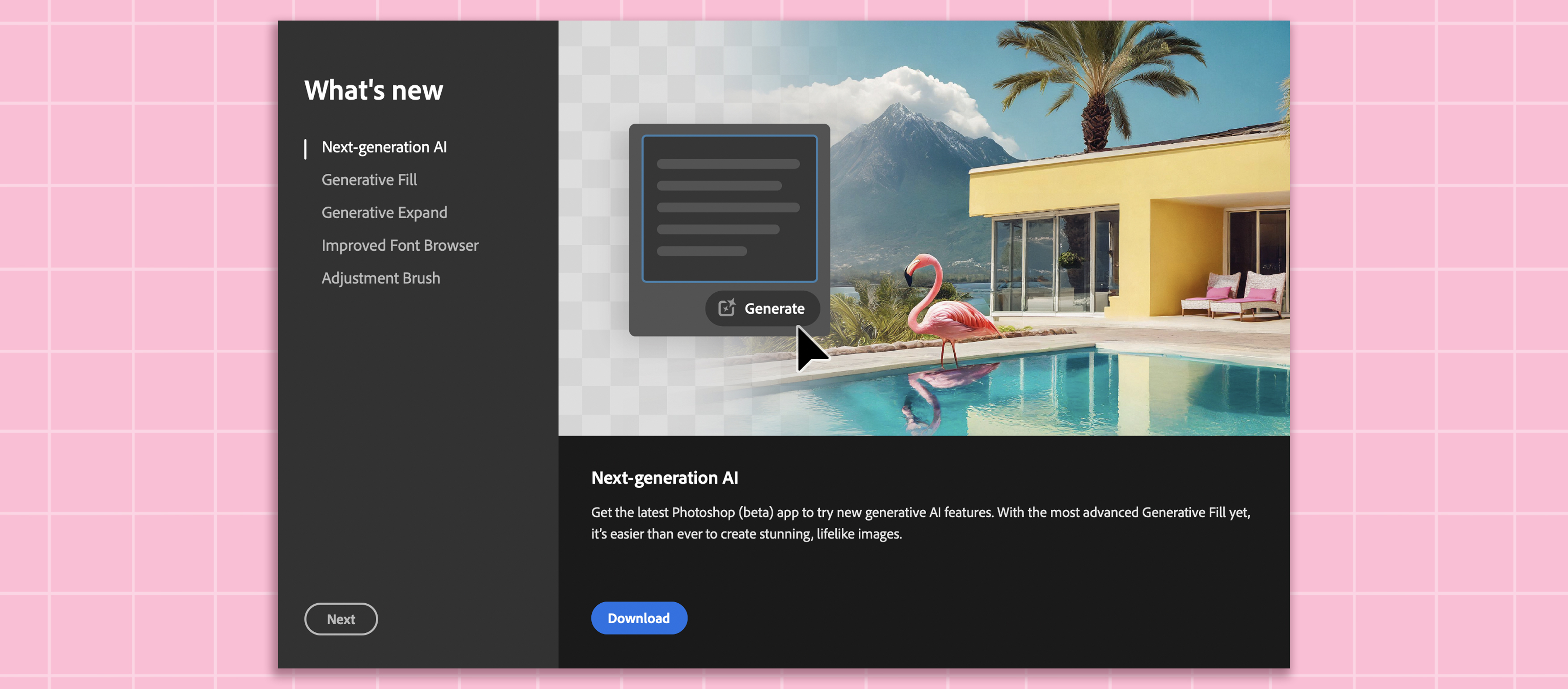
Sounds good – but are there any ethical implications of using generative AI to produce this type of creative content? This is where the Great AI Debate becomes contentious. The makers of ChatGPT are the first to say that it can produce incorrect (and potentially harmful) information, though they’re obviously working hard to fix it. As it isn’t capable of thinking for itself, it’s only as good as the information it has access to – and there is zero transparency around the sources (or dataset) the tool was trained on. This is problematic for many reasons – some of the sources contain obvious biases (e.g. racial or gender stereotypes), it is unable to provide references so it’s hard to know when or if copyright has been infringed and, in some cases, ChatGPT uses placeholder data which the user may or may not realise that they’re then supposed to replace with accurate statistics.
It’s a similar story when it comes to illustration generators such as MidJourney. In November, a lawsuit was filed accusing generative AI companies, including MidJourney, of using a list of over 4,700 artists, including renowned figures like Norman Rockwell and Wes Anderson, to train their generative AI systems to produce artwork. Filed by artists, the lawsuit argues that ‘AI-generated art is built on “human intelligence and creative expression” without the involved parties’ consent or credit.’

Misinformation and copyright issues aside, we’re not ignorant when it comes to appreciating the huge benefits generative AI can have to designers and the creative industries when their limitations and decision-making processes are properly understood. As they become more widely used, we’re discovering new ways of manipulating them to enhance workflow, simplify tasks or even trigger ideas – supporting us to work quicker and more efficiently.
So what is it about generative AI that makes us uneasy about introducing it into the edge toolkit for the time being? The simplest answer – it doesn’t quite fit with our values. At edge, we put people at the heart of everything we do. Our designs are by people …FOR people, driven by empathy and our ability to see their world, so when we create the layout for a housing development, or think about the size and shape of a back garden, or create concepts for new settlements – we imagine ourselves in those spaces, how we would feel and what our own personal experience of that place would be, in order to determine the design’s success. When we create graphics or illustrations, we find ways to sneak in details that make each other laugh, or hidden patterns that represent our brand. When writing copy, we encourage the team to let their experience and voice shine through – because those voices are what we connect with. I don’t always need to be told who has written something, sometimes it’s clear from just reading their words. If you discovered that all of the articles or social media posts we’d written and shared, or images and concepts we’d created were all generated by a tool rather than a person, would it make you feel differently about your interactions with the edge brand?
The European Parliament’s definition of AI – ‘the ability of a machine to display human-like capabilities such as reasoning, learning, planning and creativity’ is an interesting one. Reasoning, learning and planning – understandable that a machine could display these qualities. But I’d personally argue that creativity is an inherently human characteristic. Human creativity has an awareness of social and cultural context, and is able to incorporate meaning and emotion through a wealth of real life experience. AI tools rely heavily on the conformity of data, but human creativity uses imagination to form original ideas that don’t always follow rules or strict parameters. Human creativity creates connection through storytelling – we consume art to feel closer to humanity, we want to know the who, what and why. According to the Harvard Business Review, behavioural researchers have even gone as far as to call the skill of creativity a ‘human masterpiece.’
For now, it’s a no thank you from myself and edge in terms of generative AI, until we can properly understand where it fits into the edge-way of creative storytelling (and its output becomes less of a grey area). So to wrap this up, I wanted to share a brilliant article written by Jon Cockley, a co-founder of illustration agency Handsome Frank, that perfectly summarises why human creativity and the role of the artist will always be more valuable than anything created by generative AI.
Written by Sophie (not ChatGPT)

