
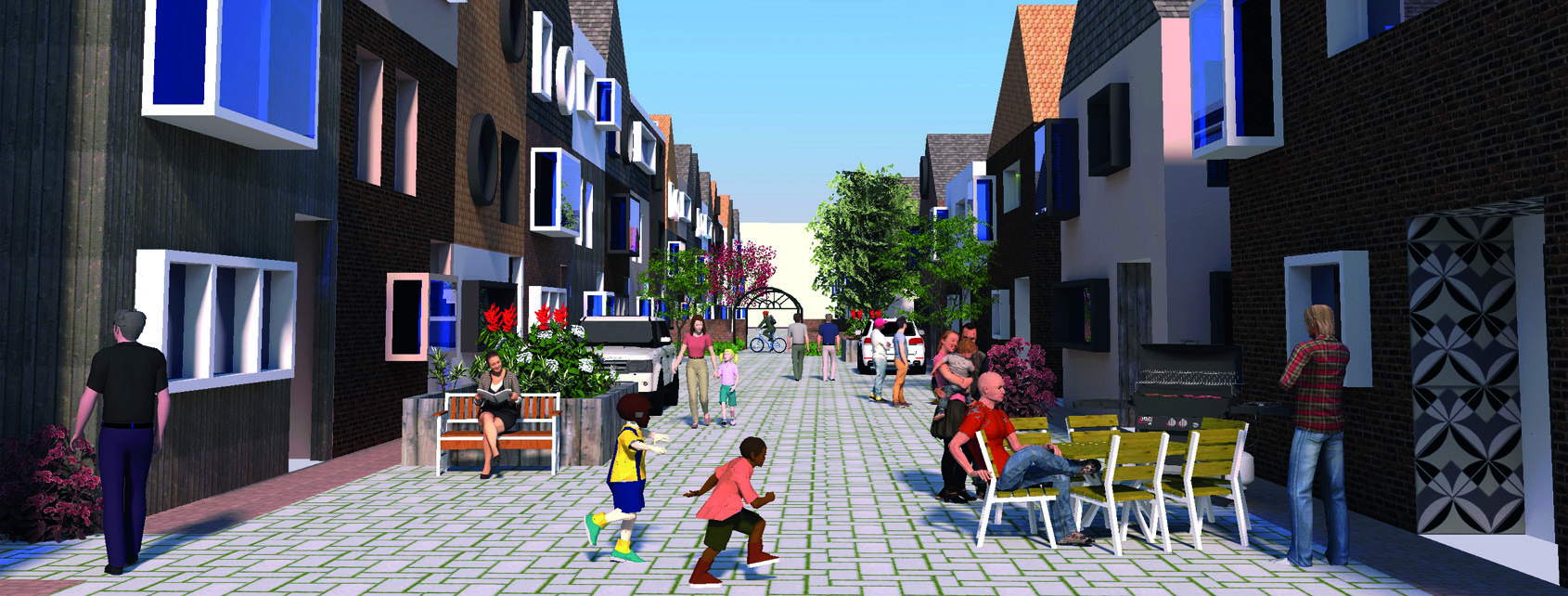
Germi-Nation: A New Urban Movement

Developed as part of my dissertation for my Urban Design Masters at Oxford Brookes, I created a dynamic intensification movement which modernises development principles instituted by Ebenezer Howard and Ian Nairn.
THE INSPIRATION
The UK currently builds our sprawling greenfield estates at 22 dwellings per hectare – too low to viably support public transport or diverse land uses (pubs? What pubs!). As a result, 20 of today’s proposed Garden Cities will generate up to 200,000 vehicle-dependent households, churning up our irreversible countryside in the process.
Howbeit, if the UK instead developed on brownfield land at 60-100dph, we could:
- Deliver an additional 4-6.6 million new homes per annum;
- Provide more shops and strengthen the High Street;
- Unlock land for a greater, greener public realm and create exciting experiences within;
- Protect rural habitats and landscapes;
- Present greater entrepreneurship and employment opportunities;
- Create more vibrant, mixed- use neighbourhoods within a 10 minute/ 800 meter walk (‘Neighbourhood Completeness’);
- Inject the ingredients to stimulate wider social, economical, and environmental regeneration.
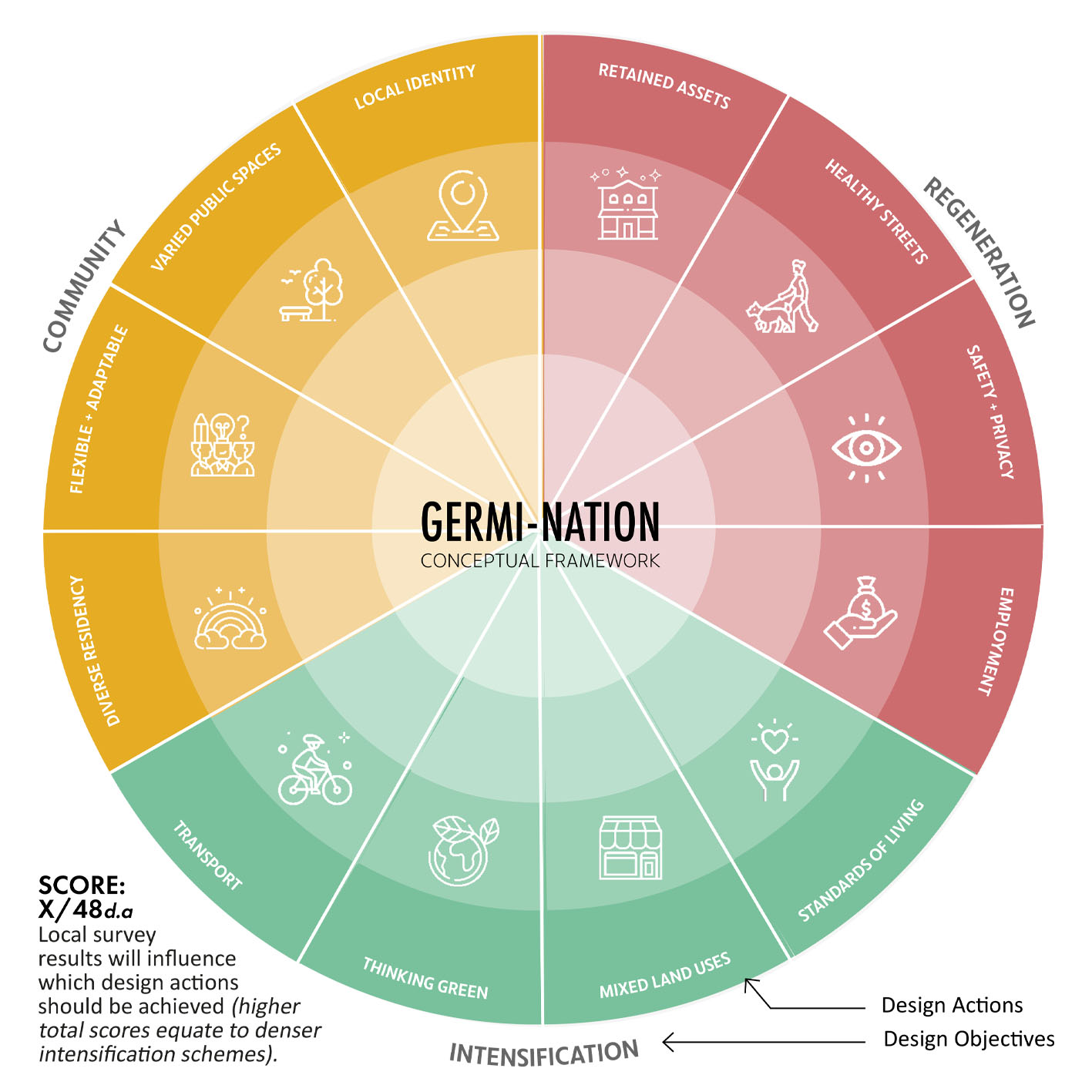
THE HOW & WHAT
Germi-Nation is defined as ‘the vertical, regenerative growth of decaying urban townscapes simultaneously with the horizontal burgeoning of natural landscapes which facilitates community nourishment’.
- ‘Germi-Nation’ guides the design of sustainable regenerative intensification schemes by blending the benefits of urban compactness with the beauty of the countryside. This movement essentially utilises ‘the sky’ (2-12 storey buildings) and smaller block blueprints to achieve higher densities, unlocking land for more sustainable and publicly accessible land uses.
- More specifically, Germi-Nation focuses on how the public realm can enhance existing brownfield assets so that these revitalised neighbourhoods retain an individual identity, distinguishable from conventional greenfield estates. This can thereby provide residents with a greater sense of pride and belonging in where they live, work and play.
- Germi-Nation lastly aims to reflect the physical aspirations of people, influencing their deep-rooted behaviours so that they can self-promote brownfield intensification schemes rather then being pressured into doing so. This bottom-up approach should cause developers and authorities to instinctively prioritise more compact, regenerative neighbourhoods over copy-and-paste greenfield estates.
To achieve this research, a collection of urban design actions derived from a literature review and survey helped formulate a conceptual framework. This is to be utilised as a checklist (X/48d.a), helping organisations reflect Germi-Nation across each layer of an intensification project.
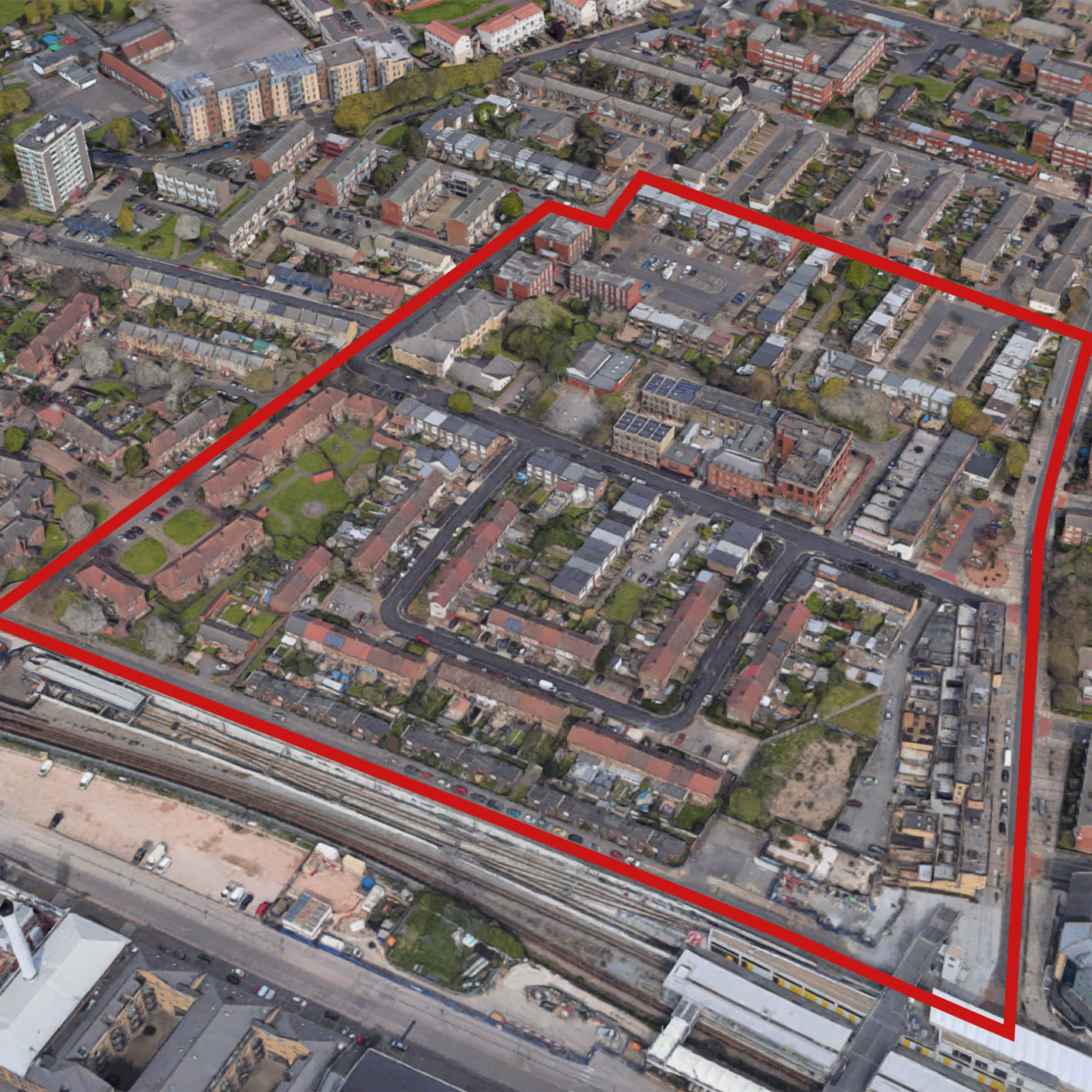
Germi-Nation was applied onto a test site in Canning Town, Newham (one of the top 10% deprived neighbourhoods in the UK) to provide a contextual example whilst indicating the research success.
THE YIN + YANG
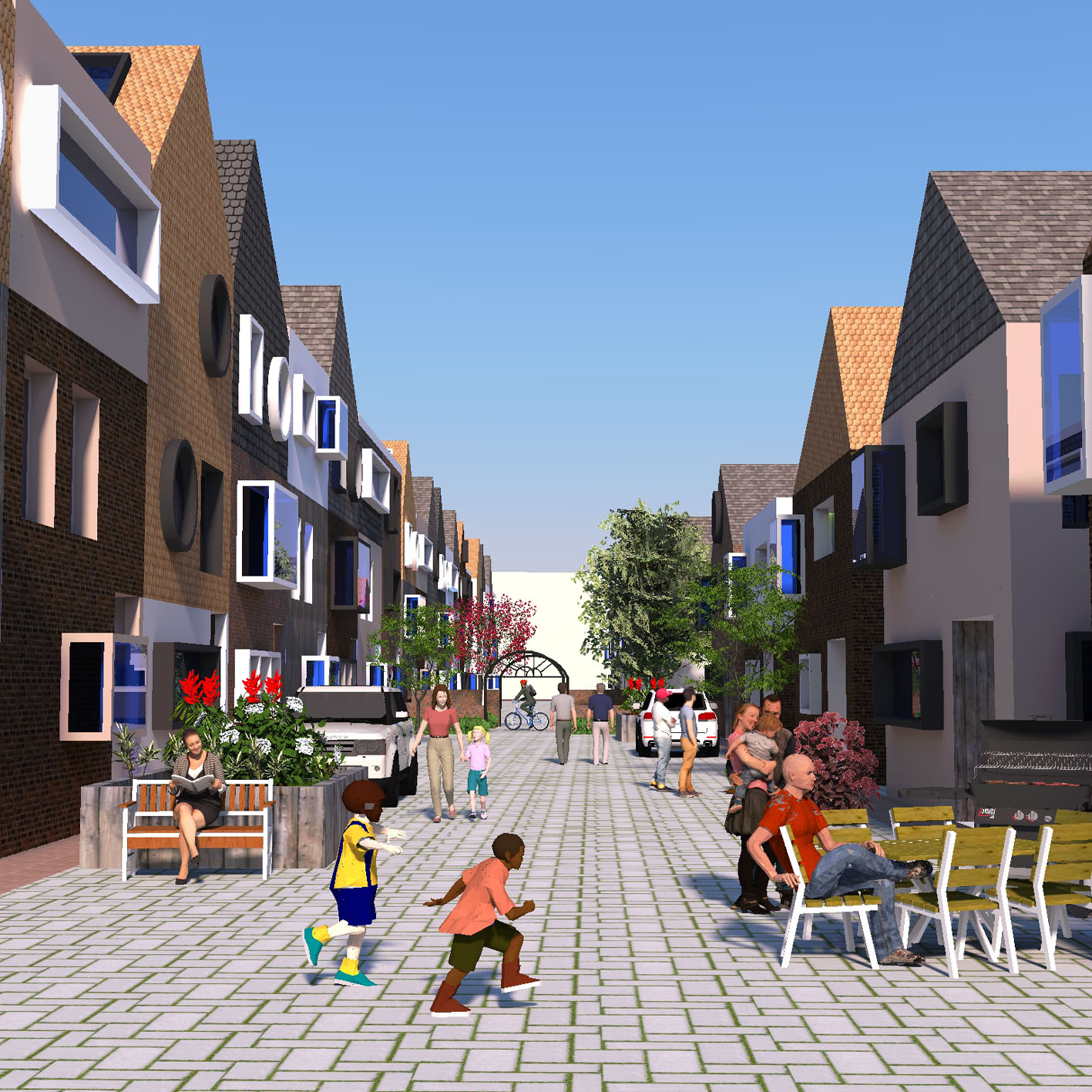
It was discovered from the 162 response survey that Canning Town residents desire large, detached plots within a community-led neighbourhood which exerts a village ambience, with a strong local identity and opportunity to customise. The 18 resultant design actions coincidentally reflect Garden City principles – a movement stimulated by Ebenezer Howard in 1898.
To the contrary, the design actions extracted from the literature review mirror the principles generated by Ian Nairn – an architectural critic who stated that Garden Cities are ‘an admirable idea in vacuo’, however ‘the greater our population, the bigger and greener should be our countryside, the neater and more compact should be our towns’.
Thus, when a niche population dreams of living in an idyllic rural suburbia, but the future sustainability of UK housing calls for compact urban jungles, where is the balance met? It is met through the sensitive scale of Germi-Nation.

THE INTENSIFICATION
The test design aimed to address the most critical areas of deprivation regarding ‘Barriers to Housing and Services’, ‘Crime’ and ‘The Living Environment’. Using Germi-Nation, this intensification scheme transformed:
- Derelict land adjacent to the DLR Station into a vibrant, mixed-use local centre;
- An underutilised landmark building into a community hub;
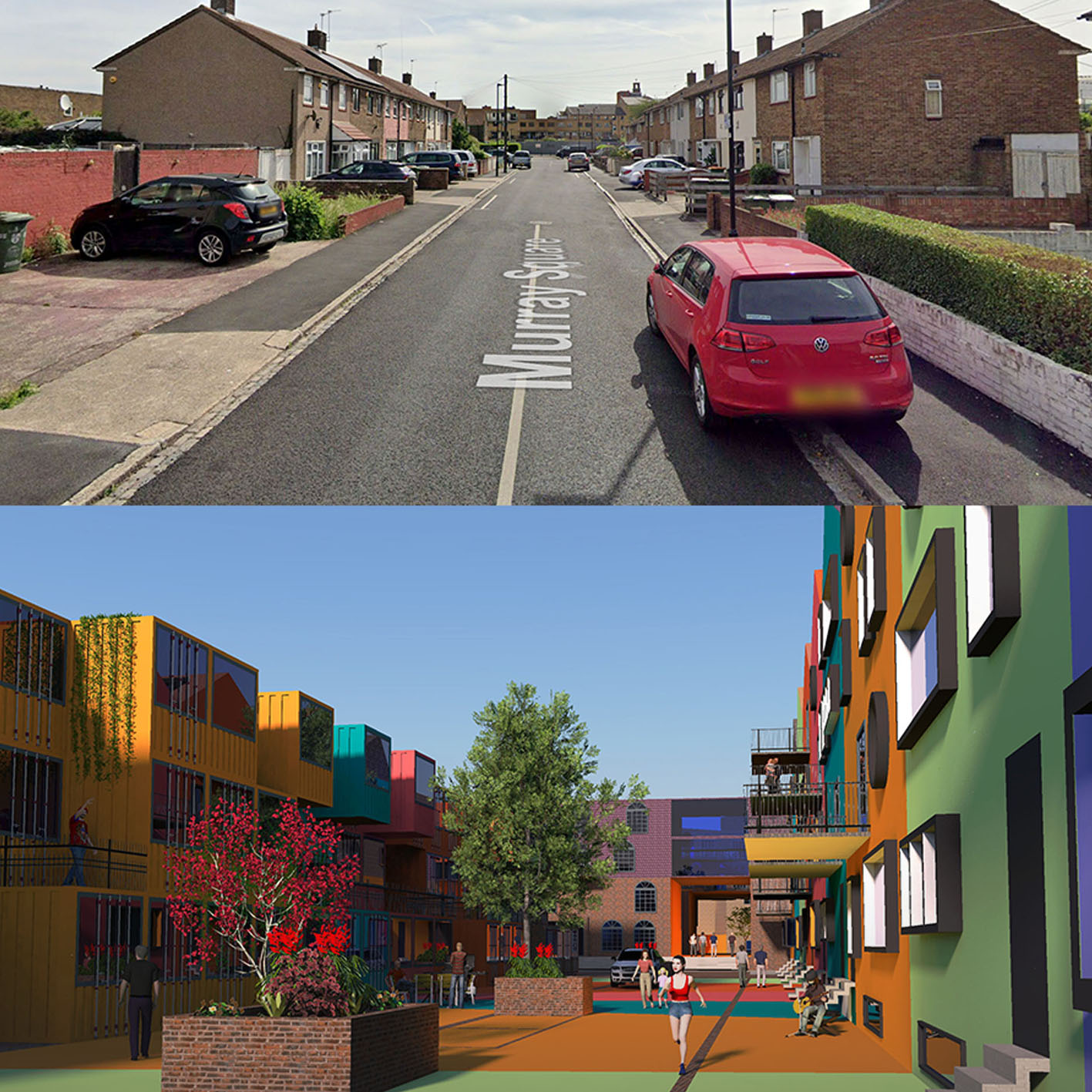
- Low quality, low density housing into a row of colourful shipping container apartments;
- An empty car park into shared streets with customizable plots;
- Abandoned shops into a skills development centre;
- Tired pocket parks into a green necklace of public parks.
The outcome of such a scheme achieved residents aspirations and resulted in a dynamic, distinctive neighbourhood which benefits from a boosted Neighbourhood Completeness from 28% to 59%, and the creation of 6.5 times cycle spaces as vehicle. By utilising vertical growth, densities could also be doubled from 40dph to 97dph which resulted in a 420% expansion of the public realm (not including streets).
Consequently, this intensification of the 7.7 hectare site produced a positive response rate of 80% by Canning Town residents following the online masterplan consultation; and additionally half of the respondents agreed that they would prefer to live in this intensified neighbourhood then a new, low-density suburban estate.

NEXT STEPS
Germi-Nation provides guidance on how to design sustainable intensification schemes whilst meeting citizens aspirations. As a result, the scale of Germi-Nation will alter depending on the context.
For example, city dwellers are prepared to live more compact lifestyles and therefore achieving a score of 25-48d.a would be expected; whereas 13-24d.a might better suit the tastes of suburban populations (around 40-50dph, for example) which should gradually promote more compact homes as they utilise the benefits of such lifestyles.
The UK’s shift from low-density developments to those higher as in the Netherlands will not be fast, but is necessary for the long-term sustainability of UK housing. And ultimately, if we are to do it, we are to do it cohesively as a nation.
Written by Astrid

